


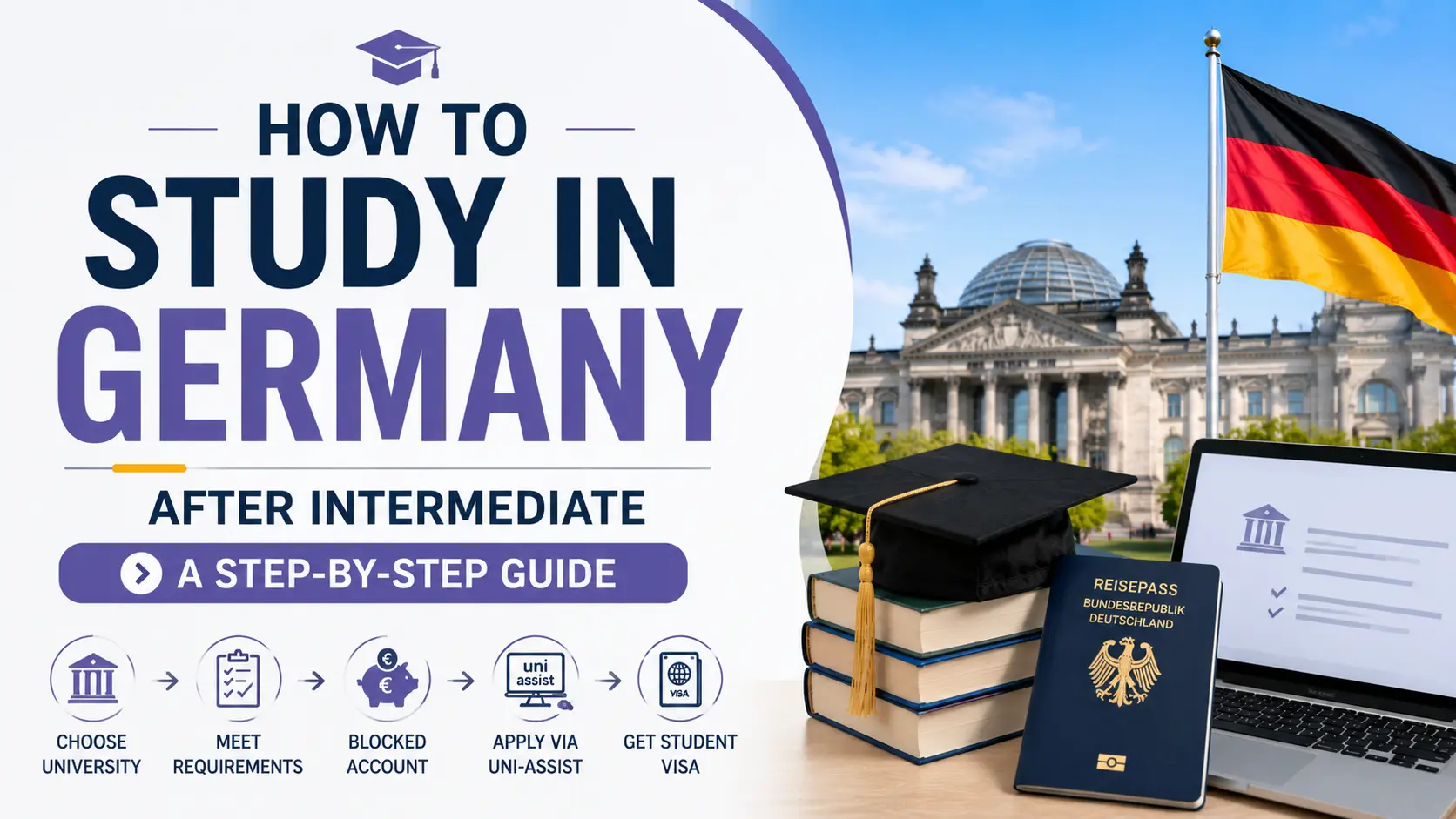
You can study in Germany right after your intermediate or 12th grade. Find a public university with English-taught programs, meet the entrance requirements, open a blocked account with €11,904, apply through UniAssist before the July 15 or January 15 deadline, and secure your student visa. Most public universities charge no tuition fees.
Finished your intermediate and dreaming of a German degree? You’re closer than you think. Germany welcomes thousands of international students every year, and you can start your bachelor’s program straight after 12th grade.
For Pakistani students especially, Germany has become a top destination. According to the most recent 2026 statistics, over 9,800 Pakistani students are pursuing higher education in Germany, placing Pakistan among the top ten countries sending students there. The reasons are clear: tuition-free public universities, globally recognized degrees, and strong career prospects after graduation.
This guide walks you through every step, from picking the right university to landing your visa. By the end, you’ll know exactly what to do and in what order. Let’s get started.
Why Choose Germany for Your Studies?
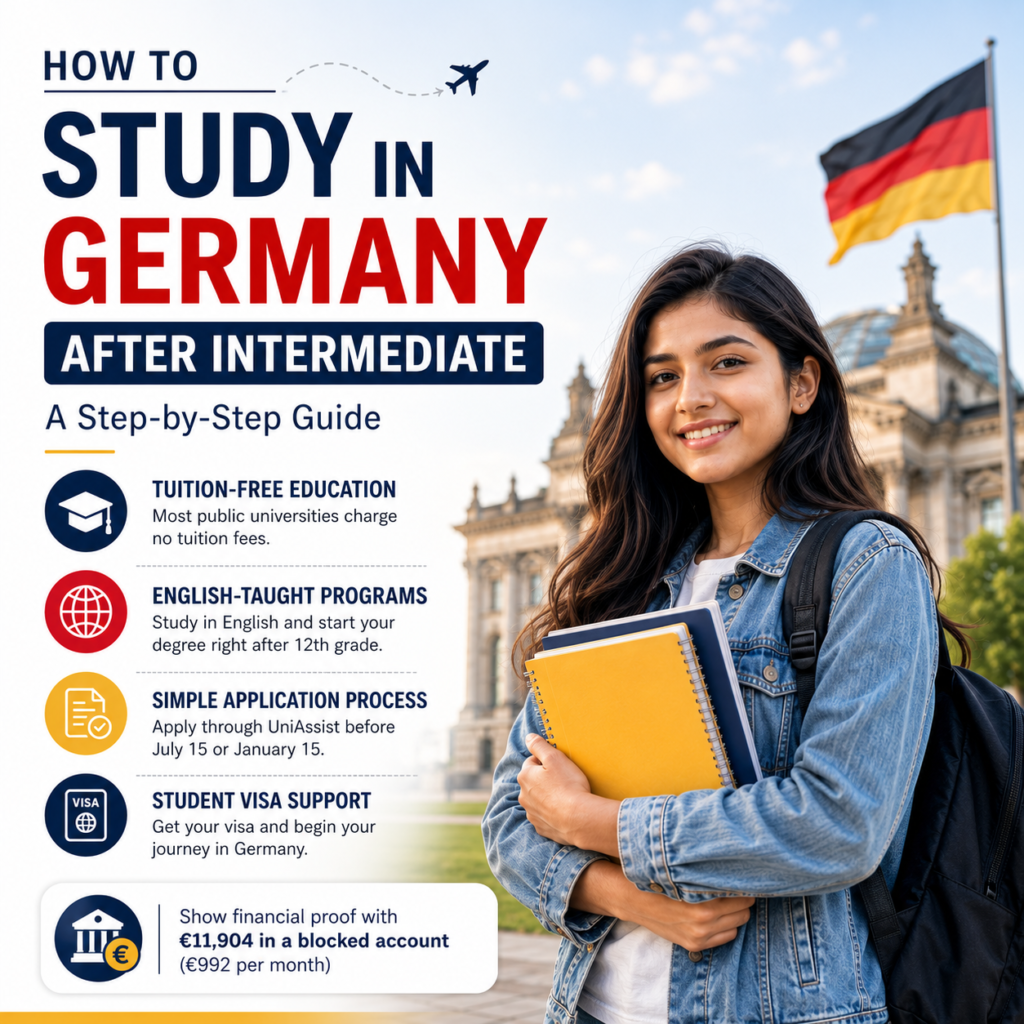
Germany offers something rare: a top-quality education that doesn’t drain your savings. Most public universities charge no tuition fees, only a small semester contribution of around €300.
German universities are also research-heavy and globally respected. Forty-five of them rank among the top universities in the world by QS rankings. A degree from Germany carries weight wherever you go.
Here’s what makes Germany stand out for students from Pakistan and beyond:
-
- Tuition-free education at most public universities
-
- English-taught programs, so you don’t need fluent German to start
-
- Globally recognized degrees that open doors worldwide
-
- State-of-the-art facilities and world-class academic staff
-
- Strong job market with stay-back options after you graduate
Understanding the German Higher Education System
Before you apply, it helps to know how German universities are organized. The system differs from what you’re used to in Pakistan, so understanding it now makes your choice easier later.
German higher education is divided into three main types of institutions:
-
- Universities (Research and Technical): These focus on theory and academic research. They offer a wide range of degrees, including doctoral studies.
-
- Universities of Applied Sciences: These emphasize practical skills and industry training. You’ll get hands-on learning and internships that prepare you for a specific career.
-
- Colleges of Art, Film, and Music: These specialize in creative fields like fine arts, design, performing arts, and media.
Germany has over 400 higher education institutions, and more than 300 are public universities. Public universities are the ones offering tuition-free education, so they’re often the smartest choice for affordable study.
Step-by-Step Guide to Applying to a German University
Ready to apply? Follow these steps in order, and you’ll move through the process with confidence.
Step 1: Choose the Right University
Start by finding a course and university that fit your goals. Don’t rush this decision,it shapes the next few years of your life.
Consider these factors as you compare your options:
-
- University ranking and reputation
-
- Course content and how well it matches your interests
-
- Location and cost of living in that city
-
- Library, sports, and leisure facilities
-
- Whether you have family or friends nearby
Step 2: Check the Entrance Requirements
Each university sets its own requirements, so check the program page carefully. Most universities first verify your higher education entrance qualification.
For students coming after intermediate, this means your 10+2 mark sheets matter. Most universities ask for at least 55–60% in your intermediate exams. Requirements vary by course and university, so always confirm the details on the official website before you apply.
Step 3: Plan Your Finances
Germany requires proof that you can support yourself during your studies. The most popular way for Pakistani students to show this is a blocked account.
You’ll need to deposit €11,904 into a blocked account, which lets you withdraw €992 per month for living expenses. This €992 figure is the official minimum the visa authorities require.
You can also meet the financial requirement through a scholarship, a sponsor’s letter of commitment, or your parents’ income documents. For most students, though, the blocked account remains the simplest route.
Step 4: Submit Your Application
You can apply online, by post, or in person. The online route is the most popular because it saves both time and money.
Most German universities accept applications through UniAssist, a shared online platform. Universities not on UniAssist run their own portals. Either way, you’ll usually need to scan your documents as PDF or JPG files.
Watch the deadlines closely:
-
- July 15 for the winter semester
-
- January 15 for the summer semester
Apply as early as the window opens. That way, you have time to fix mistakes or send missing documents. Universities receive thousands of applications, so processing can take several weeks.
Step 5: Apply for Your Student Visa
Once you receive your admission letter, you can begin your visa application. Pakistani students apply at the German Embassy in Islamabad or the German Consulate General in Karachi, depending on their province.
Prepare these documents for your visa appointment:
-
- Your university admission letter
-
- Proof of financial resources (a minimum of €11,904 per year)
-
- Proof of health insurance in Germany
-
- University entrance qualification
-
- Certificate of language proficiency
-
- Two completed application forms
-
- A valid passport
-
- Two biometric photographs
-
- Proof of paid visa fee,€75 (around PKR 24,000)
Step 6: Sort Out Your Health Insurance
German law makes health insurance compulsory for all students. You can’t enroll without it.
If you’re under 30 and enrolling at a German university for the first time, you choose between public and private insurance. Public insurers like AOK or TK are the standard choice. If you pick private insurance, you must first get an exemption document, called a “Befreiungsbescheinigung,” from a public insurer.
One important note: if you exempt yourself from public insurance, that decision is binding for your entire studies until you turn 30.
Step 7: Find Your Accommodation
Most German universities don’t offer student housing, or have very limited spots. So start your search early once you have your place and visa.
You have several options:
-
- Student halls of residence (dormitories): Often the most affordable
-
- Shared apartments (WG): Popular and budget-friendly
-
- Private apartments: More expensive but more independent
Accommodation costs range from €300 to €800 per month, depending on the city and type of housing. Big cities like Munich and Stuttgart cost more than Berlin. After you move in, remember to register your address at the local Einwohnermeldeamt or Bürgeramt.
Step 8: Enroll in Your Course
Once you’ve accepted an offer, you complete your enrollment. You’ll pay a semester administrative fee, usually between €150 and €300. If you use public transport, expect to pay around €180 for a semester ticket that covers six months of travel.
Bring these documents to enroll:
-
- Your passport with visa or residence permit
-
- Passport photos
-
- Completed enrollment form
-
- Proof of entrance qualification (originals or certified copies with translation)
-
- Your admission letter
-
- Proof of language proficiency
-
- Proof of statutory health insurance
-
- Confirmation of your semester fee payment
Popular Fields of Study and Top Universities
Germany offers strong programs across every stream. Here are some of the most popular fields for students starting after intermediate, along with leading universities for each.
Economics and Finance
A favorite among commerce students, with strong career prospects worldwide. Top universities include:
-
- University of Mannheim
-
- Ludwig-Maximilians-University Munich
-
- University of Bonn
-
- Freie University Berlin
-
- University of Göttingen
Accounting
Another solid choice for commerce students, with globally recognized degrees. Consider:
-
- Humboldt University of Berlin
-
- Technical University of Munich
-
- Goethe University Frankfurt
-
- University of Mannheim
-
- WHU – Otto Beisheim School of Management
Business and Management
A popular path that can lead to an MBA later. Strong business schools include:
-
- Technical University of Berlin
-
- SRH University Campus Stuttgart
-
- University of Cologne
-
- Reutlingen University
-
- University of Bremen
Engineering
Germany is one of the best places in the world to study engineering. Top universities include:
-
- Technical University of Munich
-
- RWTH Aachen University
-
- Technische Universität Berlin
-
- Karlsruhe Institute of Technology (KIT)
-
- Technische Universität Darmstadt
Natural Sciences
For students drawn to physics, chemistry, or biology, Germany’s research focus is a major plus. Leading universities include:
-
- TU Berlin
-
- Ludwig-Maximilians University Munich
-
- University of Bayreuth
-
- RWTH Aachen University
-
- University of Stuttgart
General Requirements for International Students
Most German universities ask for the same core set of documents. Prepare these early to keep your application on track:
-
- Mark sheets of 10+2 with at least 55–60%
-
- English proficiency proof, as required by your university
-
- A valid passport
-
- A resume or CV
-
- A motivation letter (depending on the program)
-
- Letters of recommendation, if needed
Good news for many students: you don’t always need IELTS. If your previous education was taught in English, some universities accept your medium of instruction as proof. Always check the specific program requirements before you apply.
Your German Education Journey Starts Now
Studying in Germany after intermediate is an achievable goal, not a distant dream. With tuition-free public universities, English-taught programs, and globally respected degrees, Germany rewards the students who plan ahead.
Take it one step at a time. Choose your university, meet the requirements, prepare your finances, and apply before the deadline. Each step brings you closer to studying in one of the world’s top education systems.
When you’re ready to begin, iml is here to guide you through every stage,from picking the right program to preparing for your visa interview. Your global future starts with a single step, and you can take it today.
Frequently Asked Questions
Can I study in Germany right after intermediate or 12th grade?
Yes. You can enroll in a bachelor’s program in Germany straight after your intermediate or 12th grade. You’ll need mark sheets showing at least 55–60%, proof of language proficiency, and a recognized higher education entrance qualification.
How much money do I need to study in Germany?
You must show at least €992 per month for living expenses. Most students prove this with a blocked account holding €11,904 for the year. Most public universities charge no tuition fees, only a semester contribution of around €300.
Do I need to know German to study there?
Not necessarily. Many public universities offer English-taught programs, so you can start with English alone. You will, however, need to prove your English proficiency, though learning some German helps with daily life.
Can I study in Germany without IELTS?
Yes, in many cases. If your previous education was taught in English, some universities accept your medium of instruction as proof instead of IELTS. Check each program’s requirements to confirm.
What are the application deadlines for German universities?
Apply by July 15 for the winter semester and by January 15 for the summer semester. Deadlines can vary by university, so always confirm on the official website and apply as early as possible.
How much is the German student visa fee for Pakistani students?
The visa processing fee is €75, around PKR 24,000 for adults. You apply at the German Embassy in Islamabad or the Consulate General in Karachi, depending on your province.