


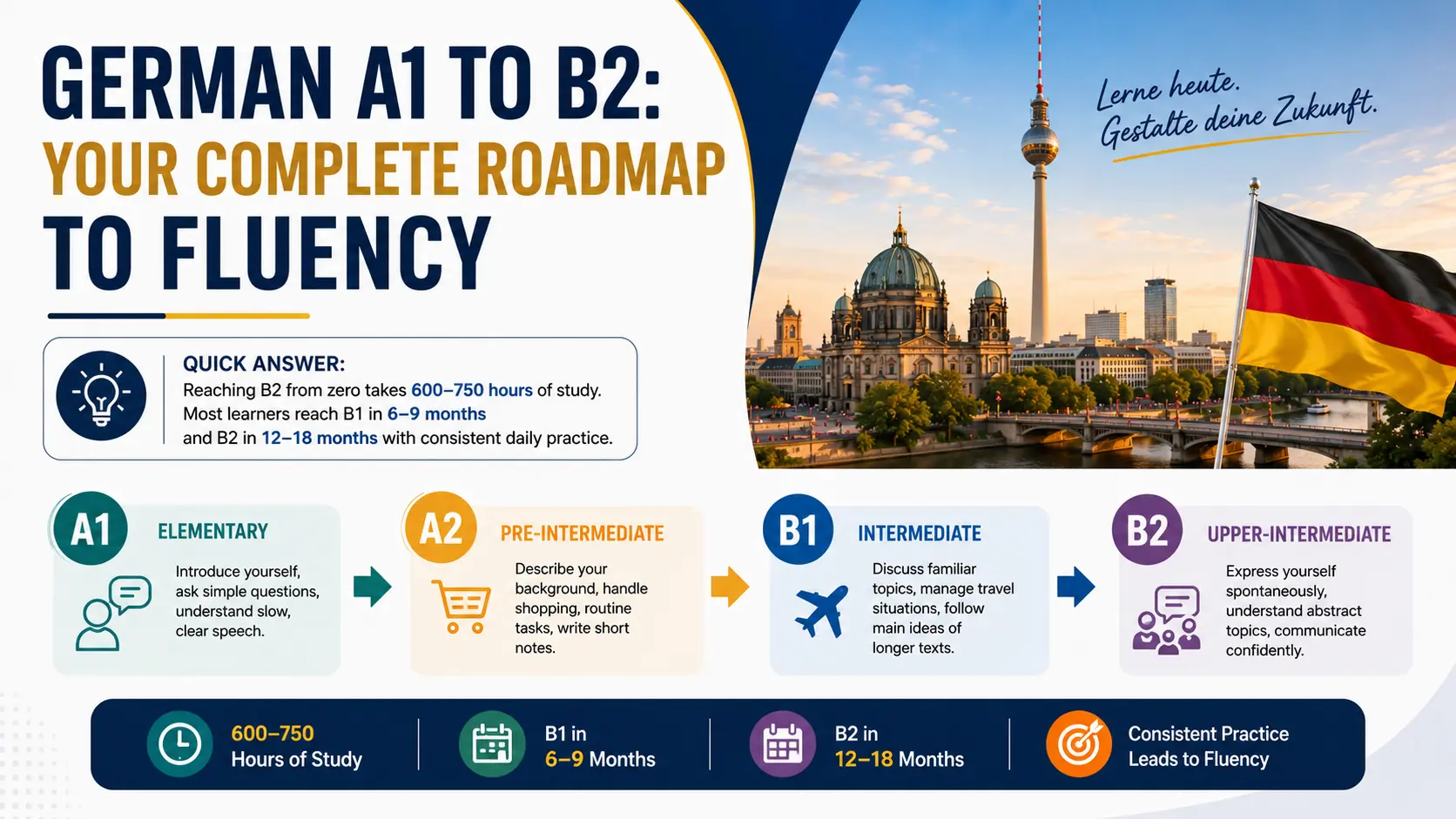
Reaching B2 German from zero takes around 600–750 hours of study, according to the Goethe-Institut and Foreign Service Institute. Most learners reach B1 in 6–9 months and B2 in 12–18 months with consistent daily practice. The journey moves through four CEFR levels,A1, A2, B1, and B2,each building on grammar, vocabulary, and real communication skills.
Many students in Lahore dream of studying, working, or building a future in a German-speaking country,but they often feel unsure where to begin. The good news? German is far more learnable than its reputation suggests. With a clear roadmap and steady effort, fluency is absolutely within reach.
This guide breaks down the entire journey from absolute beginner (A1) to upper-intermediate (B2). You’ll learn what each level requires, how long it takes, the grammar and vocabulary to focus on, and the study habits that turn slow progress into real results. Whether you study on your own or join structured German classes in Lahore, this roadmap will help you move forward with confidence.
Why Learn German, and What Do the CEFR Levels Mean?
German opens doors. It connects you with over 130 million speakers worldwide, gives you access to tuition-free universities in Germany, and strengthens your profile for global careers in engineering, healthcare, IT, and research. For many families, it’s also the first step toward relocation or work opportunities abroad.
German proficiency is measured using the Common European Framework of Reference (CEFR), which divides ability into six levels: A1, A2, B1, B2, C1, and C2. For most academic and professional goals, B2 is the key milestone,it’s the level where you can communicate fluently with native speakers, understand complex texts, and handle university or workplace conversations.
Here’s what each level means in practice:
- A1 (Elementary): Introduce yourself, ask simple questions, and understand slow, clear speech.
- A2 (Pre-Intermediate): Describe your background, handle shopping and routine tasks, and write short notes.
- B1 (Intermediate): Discuss familiar topics, manage travel situations, and follow the main ideas of longer texts.
- B2 (Upper-Intermediate): Express yourself spontaneously, understand abstract topics, and communicate confidently with native speakers.
Is German really as hard as people say?
Not at all. German has a reputation for being difficult, but much of that fear is overstated. Yes, it has four grammatical cases, three noun genders, and some famously long compound words. But it also rewards learners with consistent pronunciation rules, logical word formation, and plenty of vocabulary shared with English,think Haus (house), Mutter (mother), and Garten (garden). With structure and steady practice, German becomes a system you can master, not a mystery.
How Long Does It Take to Reach B2 German?
The honest answer depends on your starting point, study consistency, and how much German surrounds your daily life. The Foreign Service Institute estimates roughly 750 hours of study for an English speaker to reach professional proficiency, while the Goethe-Institut estimates about 600 hours to reach B2 from zero.
Here’s a realistic breakdown of the hours needed for each level:
- A1: 80–100 hours
- A2: 150–200 hours
- B1: 350–400 hours
- B2: 600–750 hours
Your pace depends on a few key factors: how many hours you study each day, whether you practice all four skills (reading, writing, listening, speaking), and how much you expose yourself to authentic German. A learner studying intensively can reach B2 in 6 months, while someone studying part-time may take 12–18 months. Both timelines are valid,what matters is consistency.
A1 Level: Building Your Foundation (Months 1–2)
The A1 stage is all about laying a strong base. Don’t rush it,the patterns you learn now will carry you through every level that follows.
Core grammar to focus on:
- Present tense conjugation: Regular verbs follow predictable patterns (ich lerne, du lernst, er lernt).
- Noun gender and articles: Every noun is masculine (der), feminine (die), or neuter (das). Always learn nouns with their article,never just “Tisch,” but “der Tisch.”
- Basic word order: German uses Subject-Verb-Object, just like English (Ich lerne Deutsch).
- Personal pronouns: Understand the difference between du (informal) and Sie (formal).
Essential vocabulary: Start with numbers, days, months, family members, colors, common foods, and high-frequency verbs like sein, haben, machen, and gehen. Aim for 500–800 words by the end of A1.
Recommended methods: Learn 15–20 new words daily using spaced-repetition tools like Anki. Pair this with free resources like Deutsche Welle’s “Nicos Weg” video series and the Easy German YouTube channel. And don’t wait to speak,start practicing simple phrases from week one.
A2 Level: Expanding Communication (Months 3–4)
At A2, German starts to feel less like memorization and more like a system. You’ll move beyond basics and begin handling everyday situations with greater confidence.
Key grammar to master:
- Accusative case: Learn how articles change for direct objects (der becomes den for masculine nouns).
- Modal verbs: können, müssen, wollen, sollen, dürfen, möchten,these power everyday sentences like “Ich kann Deutsch sprechen.”
- Perfect tense: Talk about the past using haben or sein plus a past participle (Ich habe Deutsch gelernt).
- Separable verbs: Verbs like aufstehen split apart in sentences (Ich stehe um 7 Uhr auf).
Practical vocabulary: Add weather, household items, clothing, transportation, and time expressions. Aim for 1,000–1,500 words total.
Communication strategies: Practice describing your daily routine, talking about past weekends, and expressing simple opinions. Use listening resources like “Nicos Weg” A2 and the Slow German podcast to train your ear with natural speech.
B1 Level: Achieving Conversational Fluency (Months 5–8)
B1 is the turning point where conversations become genuinely fluid. This level takes the most time for many learners,the Goethe-Institut estimates around 350 hours from A1 to B1,so be patient with yourself.
More complex grammar:
- Dative case: Used for indirect objects and with prepositions like mit, nach, bei, and von.
- Two-way prepositions: Words like in and auf take dative for location and accusative for motion.
- Subordinate clauses: Conjunctions like weil, dass, and obwohl send the verb to the end of the clause.
- Konjunktiv II: The conditional form for polite requests and hypotheticals (Könntest du mir helfen?).
Vocabulary depth: Move toward 2,000–3,000 words, focusing on abstract concepts, opinions, and field-specific terms. Prioritize depth,learn synonyms, antonyms, and how words combine.
Resources for practice: Read graded readers, watch German series with German subtitles, and listen to Deutsche Welle’s “Langsam gesprochene Nachrichten” (slowly spoken news). This is also the stage to start regular conversation practice with a tutor or in a structured class.
B2 Level: Refining Your German (Months 9–18)
B2 is the threshold of true independence. At this level, academic and professional contexts open up, and you can express yourself on a wide range of topics.
Advanced grammar:
- Passive voice: Shift focus from the doer to the action (Das Buch wird gelesen).
- Relative clauses: Connect ideas smoothly (Der Mann, der dort steht, ist mein Lehrer).
- Konjunktiv I: Used for reported speech in formal and written German.
- Advanced linkers: Master connectors like trotzdem, außerdem, and einerseits…andererseits to sound sophisticated.
Vocabulary sophistication: Build toward 4,000–6,000 words, including nuanced synonyms, academic vocabulary, and register awareness (knowing when to be formal or informal).
Advanced study techniques: This is where authentic content takes over. Read newspapers like Die Zeit and Der Spiegel, watch films without subtitles, write structured opinion essays, and engage in debates. The goal is to think in German rather than translate.
Creating Your Personalized Roadmap: Tips for Success
A roadmap only works if you walk it consistently. Here are the habits that make the biggest difference.
Consistency over volume
Twenty to thirty focused minutes daily will outperform a single long session once a week. German grammar builds on itself, so steady exposure helps the rules sink in naturally. Daily practice,even brief,beats occasional cramming every time.
Use structured online learning
One of the hardest parts of self-study is knowing what to learn next. Structured courses remove that guesswork by guiding you through grammar, vocabulary, and skills in a logical order. Combine self-paced study with regular speaking practice for the best results.
Work with tutors and language schools
Self-study can take you far, but speaking practice with a teacher accelerates everything. A structured German language course in Lahore offers guided instruction, daily correction, and accountability,especially valuable during the B1 plateau and when preparing for exams. At IML, our certified instructors help learners move through each level with clarity and confidence, while also offering support for IELTS preparation in Lahore for those planning to study or work abroad.
Embrace immersive learning
Surround yourself with German wherever you can. Watch films, listen to podcasts during your commute, label objects around your home, and read content on topics you already enjoy. The more German you absorb, the faster your active skills will grow.
Your Path to German Proficiency
Reaching B2 German is a real commitment,around 600 to 750 hours spread across four levels,but it’s a goal thousands of learners achieve every year. The journey moves step by step: build your foundation at A1, expand communication at A2, reach fluency at B1, and refine your skills at B2. Each stage prepares you for the next.
Will you make mistakes along the way? Absolutely. But every mistake is part of the process, and consistency will carry you through the tough moments. German opens doors to world-class universities, strong job markets, and meaningful cultural connections,rewards well worth the effort.
If you’re ready to take the first step, consider joining structured German classes in Lahore with IML, where expert guidance and a clear roadmap can help you reach your goals faster. Your German-speaking future is waiting,start today.

Frequently Asked Questions
How long does it take to learn German from A1 to B2?
Most learners reach B2 in 12–18 months with consistent study, though intensive learners studying 4+ hours daily can do it in about 6 months. The total time investment is roughly 600–750 hours across all four levels.
Can I reach B2 German through self-study alone?
Yes, but only if you actively practice all four skills,including speaking and writing, which self-learners often avoid. The biggest gap in self-study is usually spoken production, so adding a tutor, conversation group, or structured class from B1 onward is strongly recommended.
Is German hard to learn for beginners?
German is considered moderately difficult for English speakers, mainly due to its four cases and three noun genders. However, it has consistent pronunciation, logical word patterns, and shared vocabulary with English,making it far more approachable than its reputation suggests.
What German level do I need to study at a university in Germany?
Most German universities require B2 or C1 proficiency, typically proven through the TestDaF or DSH exam. If your goal is university admission, plan to reach at least B2 and budget an extra 2–3 months for exam-specific preparation.
Which German exam should I take?
For general certification, visa, or job purposes, the Goethe-Zertifikat or telc exams are widely accepted. For university admission in Germany, TestDaF or DSH are preferred. Always confirm the exact exam and level your institution requires before starting exam prep.
How many words do I need to know for B2 German?
For B2, you’ll need roughly 4,000–6,000 words for comprehension. Much of this vocabulary is absorbed passively through reading and listening, so you don’t need to memorize every word actively,consistent exposure does much of the work.