

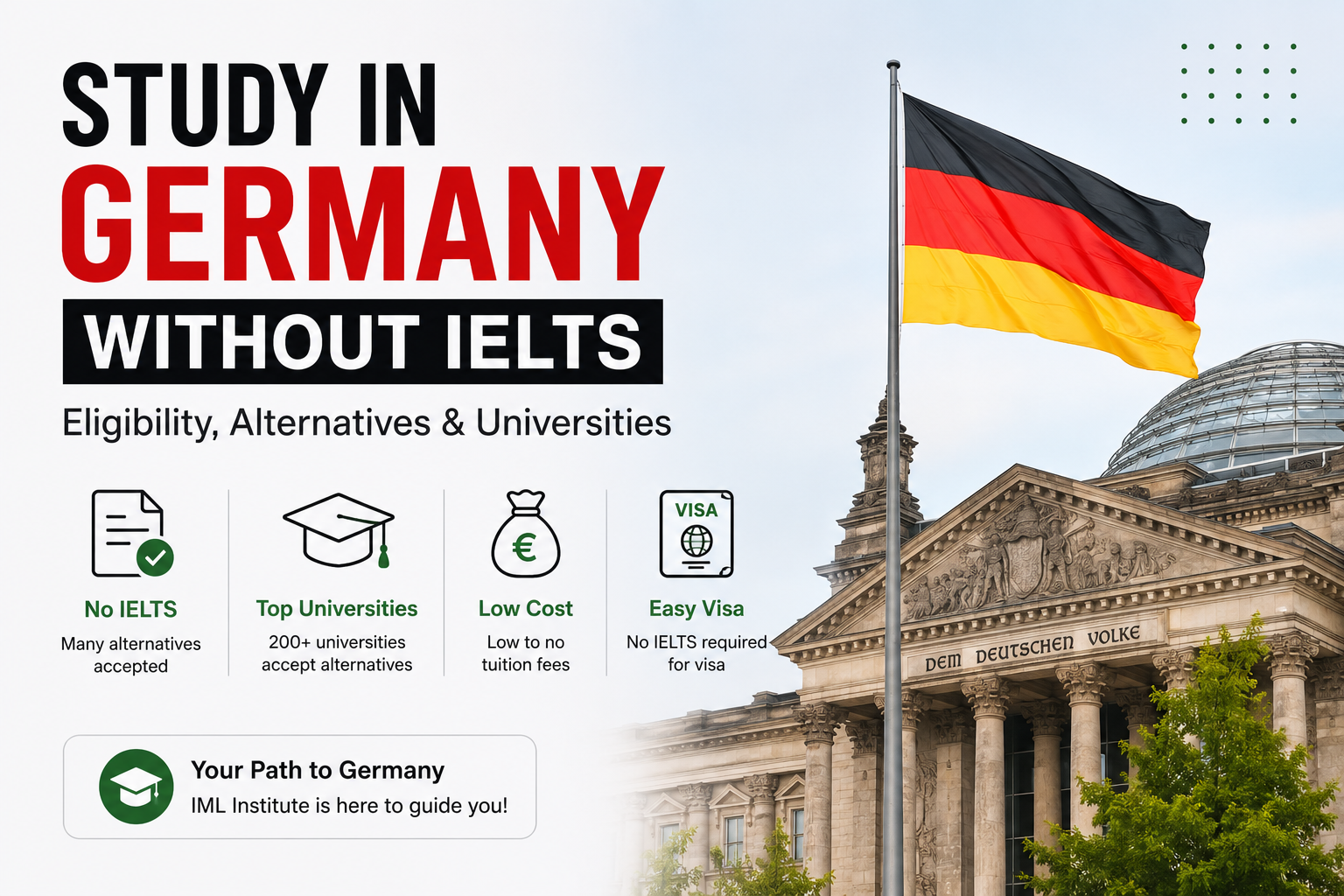
Germany attracts thousands of international students every year, and it is easy to understand why. Public universities offer low to no tuition fees, degree programs are globally recognized, and graduates benefit from strong employment prospects across Europe. For many students, however, one question creates unnecessary hesitation: do you need IELTS to study in Germany?
The short answer is no. IELTS is not a national requirement in Germany. Understanding how the system actually works, and what you need to do instead, puts you in a much stronger position to plan your application. At IML Institute, we guide students through these alternative pathways every step of the way.
Why Germany Is Worth Pursuing
Germany consistently ranks among the top destinations for higher education worldwide. Public universities charge little to no tuition, even for international students, which makes the overall cost of a degree far lower than in many other countries. Beyond affordability, German universities maintain strong partnerships with industry, which means graduates often move into competitive roles relatively quickly after completing their studies.
The country is also genuinely welcoming to international applicants. Over 1,800 English-taught Master’s programs are available, many of which do not require IELTS as a condition of entry.
Can You Study in Germany Without IELTS?
Yes, and more straightforwardly than most students expect. Germany does not set a national English proficiency standard. Each university determines its own requirements, and over 200 German universities accept alternatives to IELTS for English-taught programs. The German Embassy also does not separately require IELTS at the visa stage. If a university accepts your proof of English proficiency and admits you, that admission letter is what matters to the visa officer.
IELTS Alternatives Accepted in Germany
German universities accept several forms of evidence in place of IELTS. The most common options include:
- Medium of Instruction (MOI) Certificate: An official letter from your previous university confirming that your entire degree, including coursework and examinations, was taught in English. This is the most widely accepted alternative at German public universities.
- TOEFL iBT: Generally accepted with a minimum score of 80 to 88, depending on the program.
- Pearson Test of English (PTE) Academic: Accepted at many universities, typically with a minimum score of 60.
- Cambridge English Certificates: C1 Advanced or C2 Proficiency qualifications are recognized at several institutions.
- German Language Certifications: A Goethe-Institut B1 or B2 certificate can qualify you for German-taught programs and some pathway routes.
- Degree from an English-speaking country: If you completed your previous studies in the UK, USA, Canada, Australia, or Ireland, many universities will accept that as sufficient evidence.
The MOI certificate is typically the most practical option for students who completed their bachelor’s degree at an English-medium institution. It is free to obtain, takes three to seven working days at most colleges, and covers you for both the university application and the visa process.
Top German Universities That Accept Applications Without IELTS
The following universities have established policies for accepting alternatives to IELTS for eligible programs. Requirements vary by course, so always verify on the specific program page before applying.
- Technical University of Munich (TUM): Accepts MOI, TOEFL, and PTE for engineering, IT, and science programs. Ranked 37th globally by QS.
- University of Heidelberg: Accepts MOI, TOEFL, and PTE across humanities, medicine, and sciences. QS rank 80.
- RWTH Aachen University: Accepts MOI and other alternatives for engineering and technology programs. QS rank 105.
- Free University of Berlin: Accepts MOI, TOEFL, and PTE for social and natural sciences.
- University of Hamburg: Accepts alternatives on a program-dependent basis.
- University of Freiburg: Accepts MOI and other alternatives depending on the program.
- University of Siegen: Welcomes applicants with evidence of prior English-medium study.
- University of Kaiserslautern: Accepts German language preparatory programs and MOI letters for many graduate courses.
Key Requirements for Indian Students
If you are applying from India, there are a few requirements specific to your application that are important to understand before you begin.
APS Certificate
The APS (Akademische Prüfstelle) certificate has been mandatory for all Indian applicants since November 2022. It verifies the authenticity of your academic documents and is required by both the university and the German Embassy. The fee is Rs.18,000, which is non-refundable, and processing typically takes three to five weeks under normal conditions. During peak season, it can extend to twelve weeks, so applying early is essential.
Blocked Account (Sperrkonto)
Before your visa appointment, you are required to deposit 11,904 euros into a blocked bank account. This money is returned to you in monthly installments of 992 euros after you arrive in Germany. The deposit itself is not a cost you lose, but the provider setup fee of 49 to 89 euros is non-refundable. Open this account only after you receive your official admission letter.
Application Through Uni-Assist
Most German universities process international applications through Uni-Assist, a centralized admissions service. The fee is 75 euros for your first application and 30 euros for each additional application in the same cycle.
Application Deadlines
German universities have two annual intakes. The winter semester (October start) has a Uni-Assist deadline of July 15. The summer semester (April start) has a deadline of January 15. These deadlines are strict, and missing them means waiting for the next intake.
Frequently Asked Questions
Do I need IELTS to study in Germany?
Not necessarily. IELTS is not a national requirement in Germany. If your previous degree was taught entirely in English, a Medium of Instruction certificate from your university is accepted by over 200 German universities in place of IELTS. Always check the specific program page, as requirements vary by course.
What is a Medium of Instruction (MOI) certificate and how do I get one?
An MOI certificate is an official letter from your university’s Registrar or Controller of Examinations confirming that your degree was taught and examined in English. You request it in writing from your examination office, citing the German university’s application deadline in your letter. Most institutions issue it free of charge within three to seven working days. The letter must include your full name, your degree program, the years you attended, and a clear statement that both instruction and examinations were conducted in English. It must also carry an official letterhead, signature, and stamp.
What is the APS certificate and why is it mandatory for Indian students?
The APS certificate is issued by the Akademische Prüfstelle, a joint initiative of the German Embassy and DAAD. It verifies that your Indian academic qualifications are genuine. No German university will finalize your admission, and no Embassy will process your visa, without it. Apply through the official APS India portal, allow at least three to five weeks for processing, and apply well before your target deadline to avoid delays during peak season.
Does the German Embassy require IELTS for the student visa?
No. The Embassy does not ask for IELTS separately. If your university admitted you on the basis of your MOI certificate or another approved alternative, that admission letter is what the visa officer reviews. You do not need to submit an IELTS score at the visa stage.
Can I apply with a provisional certificate if I have not yet received my final degree?
Yes. Many German universities accept a provisional certificate for conditional admission while your final degree is still being processed. Do not wait for the original degree certificate to begin your application.
Plan Your Next Step With IML Institute
Applying to study in Germany without IELTS is entirely achievable with the right preparation and the right guidance. The pathway is clear: confirm your target programs accept your proficiency proof, apply for your APS certificate early, request your MOI from your college, and keep a close eye on application deadlines.
It can feel like a lot to manage at once, and that is exactly where IML Institute can help. Our advisors work with you to identify the right universities for your profile, prepare your documents correctly, and navigate the application process from start to finish. Reach out to an IML Institute counselor today to get a clear plan for your Germany application.
Frequently Asked Questions (FAQs)
- What is the APS certificate, and why is it important?
The APS certificate is a mandatory document for students applying to German universities. It verifies your academic qualifications and helps ensure your eligibility to study in Germany. Obtaining the APS early is crucial to avoid delays in your application process. - How do I obtain a Medium of Instruction (MOI) certificate?
The MOI certificate can be requested from the administration office of your college or university. It confirms the language in which your coursework was conducted, often required as part of the language proficiency proof for German universities. - When should I start preparing my application for German universities?
It is recommended to start at least 6-8 months before the application deadline. This timeline ensures you have adequate time to gather all necessary documents, complete language tests, and apply for your APS certificate. - Can I apply to German universities without proficiency in German?
Yes, many German universities offer programs in English, and you may not need German proficiency for those courses. However, for programs taught in German, demonstrating German language skills (via tests like TestDaF or DSH) is typically required. - What support does IML Institute provide during the application process?
The IML Institute offers comprehensive guidance, whether it’s shortlisting universities, preparing and reviewing your application documents, or tracking deadlines. Our counselors are here to make the process smooth and worry-free for you.