



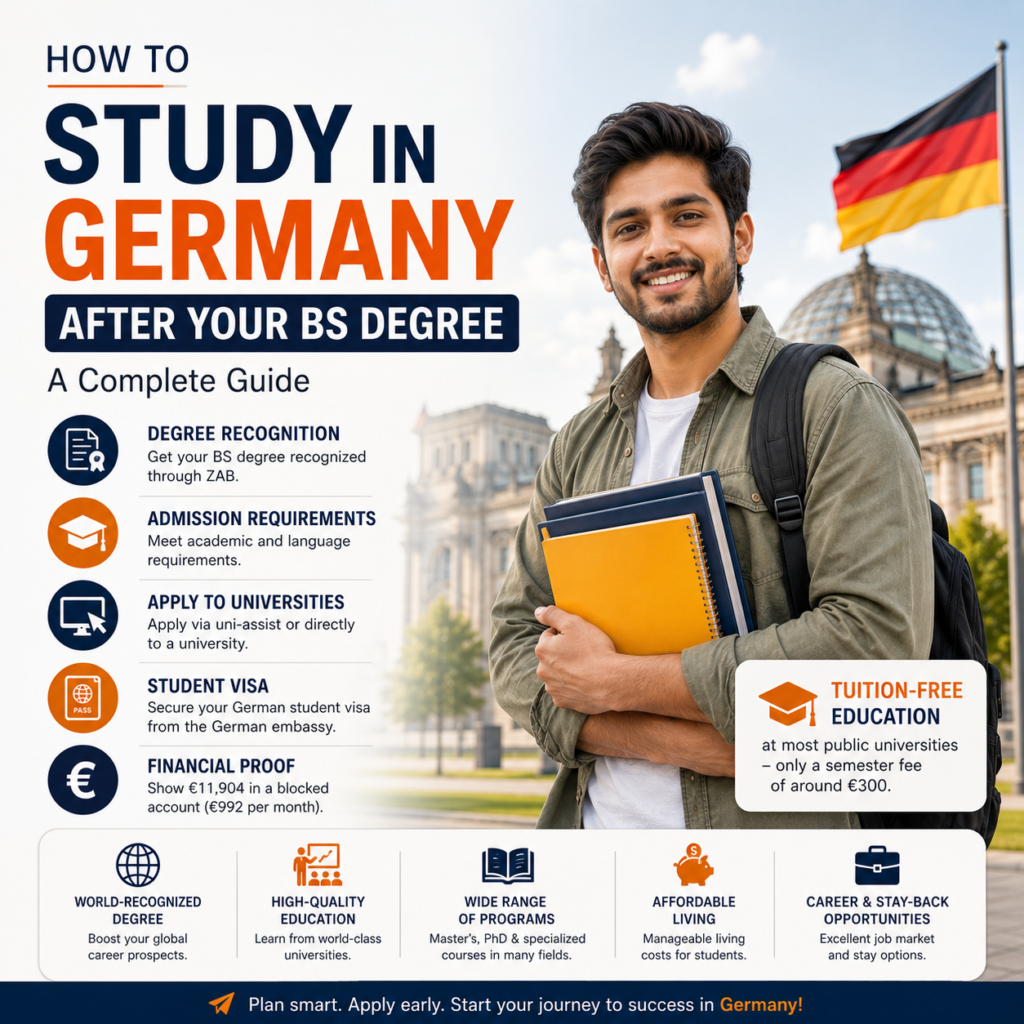
To study in Germany after a BS degree, get your qualification recognized through the ZAB, meet language and academic requirements, apply via uni-assist or directly to a university, and secure a student visa from the German embassy. You will need around €11,904 in a blocked account to prove financial resources.
Germany has become one of the top study destinations for Pakistani students. According to 2026 statistics, over 9,800 Pakistani students are now pursuing higher education there. The appeal is clear: world-recognized degrees, research-driven teaching, and most public universities charge no tuition fees.
If you have just finished your BS degree and want to take the next step, this guide walks you through the whole process. You will learn why Germany is worth considering, how its higher education system works, what documents you need, and how to handle your application and visa.
Let’s start with the reasons so many students choose Germany.
Why Choose Germany for Your Post-BS Studies?
German universities are highly research-oriented and respected around the world. Employers value a German degree, which gives you a strong advantage in the global job market.
Here is what makes Germany stand out:
- Affordable education: Most public universities charge no tuition fees,only a small semester fee of around €300.
- High-quality teaching: Universities are research-focused, with world-class academic staff.
- Modern facilities: You study with state-of-the-art equipment and resources.
- Wide range of programs: Master’s, PhD, and specialized courses across nearly every field.
- Global recognition: A German degree opens doors to careers across the world.
This mix of quality and affordability is hard to find anywhere else.
How Does the German Higher Education System Work?
Germany has over 400 higher education institutions, and more than 300 of them are public universities. Understanding how they are organized helps you pick the right one.
Higher education providers fall into three main groups:
- Universities (Research and Technical): These focus on theory and academic research. They offer the widest range of programs, including doctoral studies.
- Universities of Applied Sciences: These emphasize practical skills and industry-ready learning through hands-on training and internships.
- Colleges of Art, Film, and Music: These specialize in creative fields such as fine arts, design, and performing arts.
Public universities offer the most affordable path. If saving money matters to you, a public university is likely your best choice.
One term you will come across often is the Hochschulzugangsberechtigung (HZB), or higher education entrance qualification. German students earn this automatically. As an international student, you need to prove that your BS degree counts as an equivalent qualification.
What Are the Admission Requirements for Pakistani Students?
Getting your qualification recognized is the most important step. Without it, you cannot move forward.
How do you get your BS degree recognized?
The Central Office for Foreign Education (ZAB) compares your degree to its German equivalent. This is a federally mandated process that every international student must complete.
Once approved, you receive a Statement of Comparability, which confirms your foreign qualification matches the German system. If your degree does not transfer directly, you may need additional preparatory courses first.
You can check whether your degree is recognized using the Anabin database. Keep in mind that the site is only available in German, but the DAAD also offers an English version of the recognition database.
What other documents do you need?
Each program has slightly different requirements, so always check the program page. That said, most universities ask for:
- Academic transcripts and grades
- Proof of language proficiency (German or English)
- A Curriculum Vitae (CV)
- A copy of your passport or ID
- A letter of motivation
- Your recognized BS degree (for master’s applicants)
Why should you learn German?
Even if your program is taught in English, learning German makes a real difference. It helps you handle daily life, connect with locals, and open up more program options. Strong German skills also improve your chances during the visa process and beyond.
How Do You Apply to a German University?
You can apply online, by post, or in person. Most students choose the online route because it saves both time and money.
Many German universities process applications through a shared platform called uni-assist, based in Berlin. Around 170 universities use it to handle international applications. Note that uni-assist processes your documents,it does not decide whether you get admitted.
Universities that do not use uni-assist run their own online portals. For these, you usually scan your documents as PDF or JPG files.
After you submit your application, the university confirms it by email. Processing can take several weeks, so apply early and stay patient.
How Do You Secure Your German Student Visa?
Once you receive your admission letter, you can begin your visa application. Pakistani students must hold a German student visa to study there.
Where do you apply?
Where you apply depends on your province:
- German Embassy in Islamabad: for Islamabad Capital Territory, Punjab, Khyber Pakhtunkhwa, Gilgit-Baltistan, and Azad Jammu and Kashmir.
- German Consulate General in Karachi: for Sindh and Balochistan.
What documents do you need for the visa?
The embassy will confirm the exact details, but you should prepare:
- Your university admission letter
- Proof of financial resources (at least €11,904 per year)
- Proof of health insurance
- Your recognized university entrance qualification
- A certificate of language proficiency
- Two completed application forms
- A valid passport
- Two biometric photographs
- Proof of the paid visa fee (€75, around PKR 24,000)
For financial proof, most Pakistani students use a German blocked account. You can also use a fully-funded scholarship, a letter of commitment, or your parents’ income documents.
How Much Does It Cost to Live and Study in Germany?
To get your visa, you must show at least €992 per month for living expenses. This is the official minimum the visa authorities require.
Accommodation will be one of your biggest costs. Rent ranges from €300 to €800 per month, depending on the type, location, and your choices. The most affordable options are student dormitories and shared apartments (WG), while private accommodation costs more.
One thing to plan for: German universities do not automatically give you student housing when you enroll. Start your search early to secure a good spot.
How Do You Prepare for Your Arrival?
A little preparation makes your transition far smoother. Focus on three areas before you go.
Plan your finances. Make sure your blocked account and living budget are sorted well in advance. Knowing your numbers gives you peace of mind.
Build your German skills. Take a German course before you leave. Even basic conversation helps you settle in faster.
Learn the grading and credit systems. Germany grades on a 1 to 5 scale, where 1 is the highest and 5 is a failing mark. Universities also use the European Credit Transfer and Accumulation System (ECTS), where 60 credits equal one full year of study. A master’s program usually carries 90 to 120 ECTS credits.
Your Next Step Toward Studying in Germany
Studying in Germany after your BS degree gives you a respected degree, affordable tuition, and a real launchpad for your career. The process has several steps, but each one is manageable when you take it in order.
Start by checking your degree on the Anabin database. From there, shortlist your programs, prepare your documents, and begin building your German skills. With steady planning, your goal is well within reach.
If you want expert guidance through recognition, applications, language preparation, or the visa process, IML is ready to support you at every stage. When you’re ready to take the next step, we’ll help you get there.
Frequently Asked Questions
Is studying in Germany free for Pakistani students?
Most public universities charge no tuition fees,only a semester fee of around €300. Compared to the UK, US, or Canada, this makes Germany a remarkably affordable choice for high-quality education.
How much bank balance do you need for a German student visa?
You typically need to show at least €11,904 in a blocked account. This allows you to withdraw €992 per month for living expenses. You can also meet the requirement through a scholarship or a sponsor’s commitment.
How much is the German student visa fee from Pakistan?
The visa processing fee is €75 for adults, which is around PKR 24,000.
Do you need to know German to study in Germany?
Not always. Many programs are taught in English. Still, learning German helps with daily life, expands your program options, and strengthens your overall application.
How long does the application process take?
German universities receive a large number of international applications, so processing usually takes several weeks. Apply early to give yourself enough time before deadlines.