

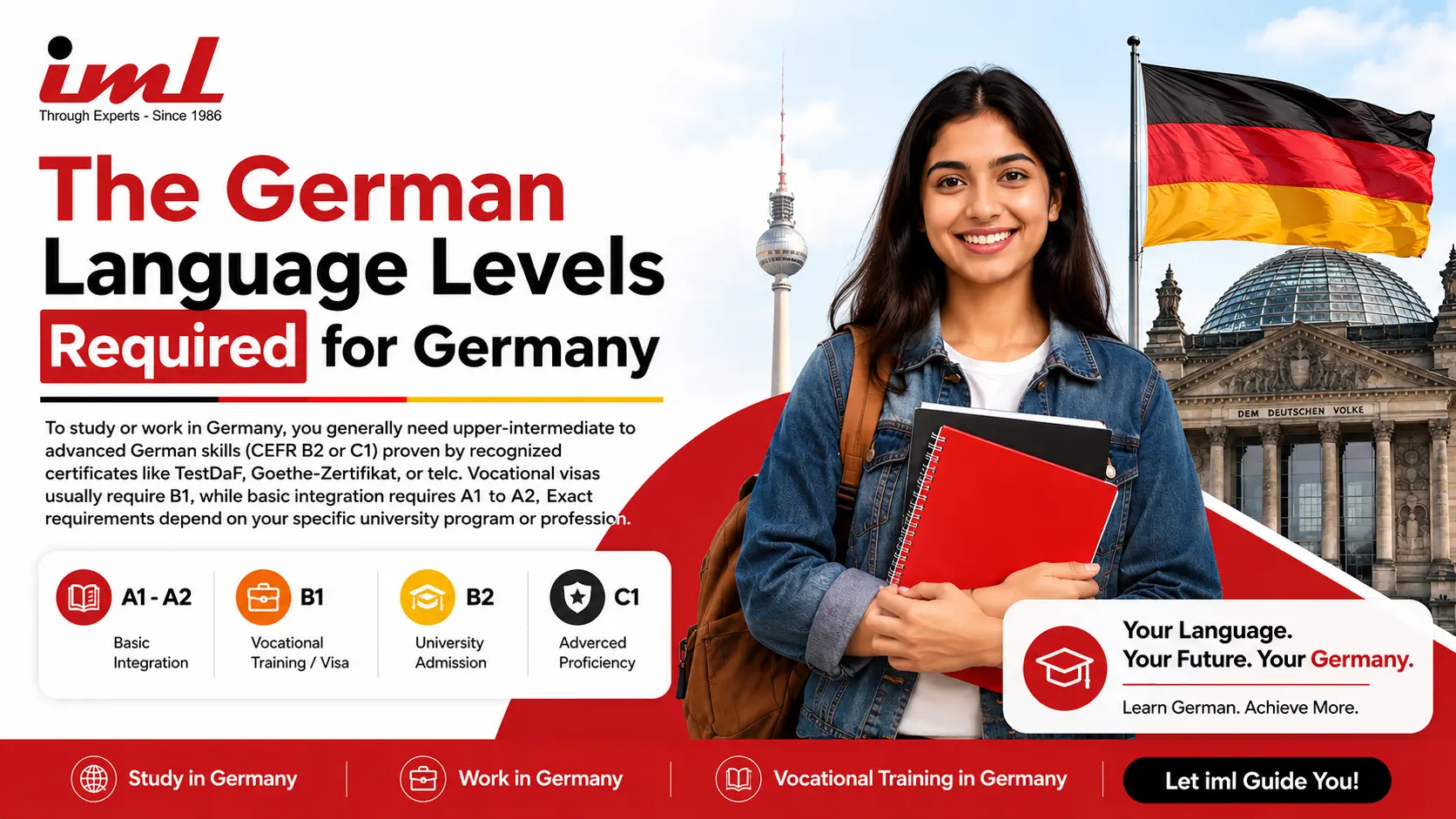
To study or work in Germany, you generally need upper-intermediate to advanced German skills (CEFR B2 or C1) proven by recognized certificates like TestDaF, Goethe-Zertifikat, or telc. Vocational visas usually require B1, while basic integration requires A1 to A2. Exact requirements depend on your specific university program or profession.
Moving to Germany for studies, work, or vocational training is an exciting step that opens doors to world-class education and global career opportunities. However, navigating the specific prerequisites for living in this dynamic European country requires careful preparation. Among the most critical steps in this journey is proving your linguistic proficiency. While some international degree programs operate entirely in English, engaging fully with the academic system, workplace culture, and local community demands a solid grasp of the German language.
Language is more than just a formal requirement for your visa application. It is the key to expanding your cultural understanding, building confidence in a new environment, and unlocking meaningful connections. From passing university entrance exams to interacting with colleagues and neighbors, speaking the local language will significantly enhance your experience and long-term success. The expectations vary widely depending on your goals, with academic institutions, regulated professions, and immigration authorities all maintaining distinct standards.
At iml, we understand that mastering a new language can feel challenging. As your trusted partner in international education, we provide comprehensive guidance to help you reach your goals. Whether you are seeking a structured German language course in Lahore or need advice on navigating university admissions, iml offers the expertise and encouragement you need to succeed.
German Language Requirements for University Study
Understanding CEFR Levels B2 and C1
When applying to German universities, you will encounter the Common European Framework of Reference for Languages (CEFR). This system classifies language proficiency on a scale from A1 (beginner) to C2 (mastery). For the vast majority of German-taught academic programs, universities require upper-intermediate to advanced proficiency, which corresponds to the B2 or C1 levels. Achieving this standard ensures you can follow complex lectures, read academic texts, and participate actively in seminar discussions without language barriers.
Recognized German Language Certificates for University Admissions
To prove your readiness, you must submit an official certificate recognized by the Standing Conference of the Ministers of Education and Cultural Affairs (KMK). The following five examinations are universally accepted across German higher education institutions:
TestDaF Level TDN 3, 4, or 5
The Test Deutsch als Fremdsprache (TestDaF) is one of the most popular standardized language exams for international students. It evaluates your skills in reading, listening, writing, and speaking. Scoring a TDN 4 in all sections generally satisfies the admission requirements for most academic programs, while some demanding subjects may require a TDN 5.
DSH Level II or III
The Deutsche Sprachprüfung für den Hochschulzugang (DSH) is uniquely administered directly by German universities. Because it is conducted on-site, it is highly affordable and tailored to academic settings. Achieving a DSH-2 is equivalent to a C1 level and is sufficient for almost all degree programs.
Goethe-Zertifikat C2
Unlike the academically focused TestDaF or DSH, the Goethe-Zertifikat is a general language examination. Because of its broader focus, universities typically require the highest possible level,the C2 certificate,to guarantee that your comprehension is sufficient for rigorous university coursework.
telc Deutsch C1 Hochschule
The European Language Certificate (telc) specifically designed the C1 Hochschule exam for prospective university students. It tests academic language usage and is universally recognized by German universities as proof of advanced proficiency.
DSD Level II
The Deutsches Sprachdiplom (DSD) is exclusively available to pupils attending specific accredited secondary schools worldwide. If your school offers this program, completing the DSD II provides you with a free, universally accepted certificate for university admission in Germany.
Special Cases and Exemptions
German International Abitur
Students who graduate from accredited German schools abroad with the Deutsche Internationale Abiturprüfung (DIA) are entirely exempt from presenting additional language certificates. This diploma is treated as equivalent to domestic German high school qualifications.
Studienkolleg and Feststellungsprüfung
If your current high school diploma does not grant you direct entry into a German university, you may need to complete a foundational year known as a Studienkolleg. Admission to a Studienkolleg typically requires a B1 or B2 level of German. After two semesters, you must pass the Feststellungsprüfung (assessment test), which serves as your higher education entrance qualification and fulfills the language requirement for your subsequent degree.
Applying with a Placeholder
In some instances, universities permit students to apply with a lower-level language certificate (a placeholder) provided they achieve the required level before enrollment. However, you must manage your time carefully, as a formal proof of language proficiency or enrollment in an intensive language course is often required for the student visa application.
Admission Requirements for International Students Beyond Language
While language is crucial, universities also evaluate your academic background. Your school-leaving certificate must be equivalent to the German Abitur. You can verify your eligibility through the DAAD admission database or uni-assist. Additionally, international students must demonstrate financial stability, typically through a blocked account containing at least 11,208 EUR per year, and secure valid health insurance before enrollment.
German Language Requirements for Professional Life
Working in Germany General Expectations
For professionals planning to advance their careers in Germany, the language requirements depend heavily on the industry and the specific employer. While multinational tech companies and startups in major cities often operate in English, possessing good German skills is essential for navigating the broader job market. Employers view language proficiency as a strong indicator of your commitment to long-term integration and your ability to collaborate effectively with local teams.
Specific Requirements for Regulated Professions
Certain careers in Germany are legally regulated, meaning you cannot practice them without official recognition of your foreign qualifications and specific language skills.
In the healthcare sector, doctors and nurses must demonstrate a B1 or B2 level of German, depending on the federal state, to obtain a professional license. Medical professionals are often required to pass a specialized medical language exam. Similarly, educators, lawyers, and specific master craftspeople must prove advanced fluency to ensure they can communicate clearly with clients, patients, and authorities.
Enhancing Job Market Prospects with German Skills
Even if your target job does not strictly require it, learning German provides a massive competitive advantage. Workplace communication often involves subtle cultural nuances that are best understood in the native tongue. Participating in vocational language courses can help you master industry-specific terminology, making your transition into the German workplace smoother and more successful.
The Role of ALTE-Certified Language Certificates
For employment and visa purposes, the German government only recognizes certificates issued by providers certified by the Association of Language Testers in Europe (ALTE). This includes organizations like the Goethe-Institut, telc GmbH, and the Austrian Language Diploma (ÖSD). Ensuring your certificate is ALTE-certified guarantees that your hard work will be officially acknowledged during the visa and professional recognition processes.
German Language Requirements for Visa and Integration
Visa Purposes and Vocational Training
Immigration authorities have distinct linguistic prerequisites for different visa categories. If you are applying for a visa to seek vocational training, you must prove B1 proficiency. For a visa intended for the recognition of foreign professional qualifications, a minimum of A2 is usually necessary.
For the Opportunity Card (Chancenkarte), which allows skilled workers to seek employment in Germany, applicants must demonstrate either an A1 level of German or a B2 level of English. However, individuals with a fully recognized academic or vocational qualification may be exempt from this language proof.
Exceptions also exist for the spouses of specific visa holders. For example, if you hold an EU Blue Card, a settlement permit for highly skilled workers, or a residence permit for research purposes, your spouse is not legally required to prove German proficiency prior to family reunification.
Facilitating Everyday Life and Social Integration
Beyond official mandates, speaking the language fundamentally alters your experience of living in Germany. Routine tasks like signing a lease, registering at the local citizens’ office (Bürgeramt), or simply grocery shopping become far more manageable. A basic to intermediate understanding of German helps you build friendships, participate in community events, and truly feel at home in your new surroundings.
Choosing the Right German Language Test
TestDaF Ideal for International Preparation
The TestDaF is an excellent choice for prospective students preparing from their home countries. It is standardized, widely accessible at international testing centers, and specifically targets the academic vocabulary required for university success.
Goethe-Zertifikat C2 The Highest Level
The Goethe-Zertifikat C2 represents near-native mastery. Because it is a general language exam, achieving this level is challenging but universally respected by both academic institutions and top-tier employers.
telc Deutsch C1 Hochschule Another Strong Option for Study
Similar to the TestDaF, the telc C1 Hochschule exam is tailored for university applicants. It is an ideal alternative for students who prefer the telc testing format but still need an ALTE-certified document accepted by German universities.
DSH Exclusively Offered in Germany
If you are already in Germany attending a preparatory language school, the DSH is highly recommended. Administered directly by universities, it is often more affordable and intimately aligned with the specific expectations of the institution you plan to attend.
DSD II For Secondary School Pupils
For students currently enrolled in DSD-accredited secondary schools, the DSD II is a seamless pathway to studying in Germany. It builds directly upon the school curriculum and eliminates the need to seek external testing centers.
Resources for Test Preparation
Preparing for these standardized tests requires the right strategy, consistent practice, and expert guidance. By enrolling in German classes in Lahore through a reputable institution, you can familiarize yourself with the exam formats, practice under timed conditions, and identify areas for improvement. Accessing targeted practice materials and professional feedback is the most effective way to ensure a strong performance on test day.
How iml Supports Your Journey to Germany
At iml, our mission is to empower learners through high-quality education and unwavering support. We know that the journey to studying or working abroad can feel complex, but you do not have to navigate it alone. From taking your first German language course in Lahore to mastering advanced grammar and securing your university admission, our expert instructors and counselors provide clear, practical guidance every step of the way.
We focus on building your confidence and communication skills so you can approach your goals without hesitation. If you are ready to take the next step toward your international future, reach out to iml today to explore our tailored language programs and study abroad counseling services.

Frequently Asked Questions
How long does it take to learn enough German to study in Germany?
Reaching the B2 or C1 level required for university admission typically takes 12 to 18 months of intensive, consistent study. The exact timeline depends on your learning pace, the intensity of your classes, and your prior language experience. At iml, our structured courses are designed to help you achieve these milestones efficiently.
What is the most affordable way to get a recognized German language certificate?
If you are already in Germany, taking the DSH exam at your prospective university is often the most cost-effective route, as universities subsidize the cost for applicants. If you are applying from abroad, the TestDaF and telc exams have standardized fees, but investing in high-quality preparatory classes at iml can prevent costly retakes.
Can I study in Germany if I only speak English?
Yes. Many German universities offer international degree programs and postgraduate programs taught entirely in English. For these specific programs, you will need to provide proof of English proficiency, which you can achieve through our expert IELTS preparation in Lahore.
Does my spouse need to learn German before moving with me?
If you hold a standard work visa, your spouse must generally prove A1 German proficiency before relocating. However, if you hold an EU Blue Card or a researcher visa, this requirement is waived. It is always highly recommended that family members learn basic German to help them settle into their new community.
What happens if I fail the TestDaF or Goethe exam?
If you do not achieve the required score, you can retake the standardized exams as many times as you need. However, each retake requires you to pay the examination fee again. To minimize risks, we recommend thoroughly preparing with practice tests and expert guidance at iml before registering for the official exam.